Thursday, January 26, 2017

Coffee (In A Cardboard Cup)

Today's title is a song from "70, Girls, 70" which is a show produced in Sun City a few years ago.

A busy day starting with a tour of a small coffee farm. Panama is a world leader in producing superior coffee. Much of it is grown on farms in the hills surrounding Boquete. We met our guide Felix in Boquete and we all took a taxi to the farm.This place we visited is certified for agroturistica and the word for a small farm is finca. La Milagrosa means miracle.


This finca is owned by a man named Tito and he has named the farm for his father Don Alfredo. This is a very special place with specialty coffees that are only sold on the farm or exported to other countries. The premier brand is called "Geisha" and they also grow Arabica.

We walked to the fields and saw the coffee trees. Different varieties of coffee are planted near each other so they can cross pollinate providing interesting blends. The trees range from one year to 70 years and the finca is aout 12 acres with 40,000 trees. Sun and shady areas support the trees. The coffee beans are ripening this time of year and they can be green ranging to bright red.


Blossoms and tiny beans starting to grow. A native family was picking beans. The children are on their summer vacation from school so helping their parents make more money as they are paid by the pound for what they pick.


We tasted the coffee beans by smashing the bean and removing the outer skin. Some companies make tea out of the skin. The beans are covered in a slimy layer and tasted sweet. The next step is to put the beans in a machine that removes the outer layer and then the beans are put in bins to dry.

The beans are then sorted by hand and bad or bruised beans are put in a compost pile.

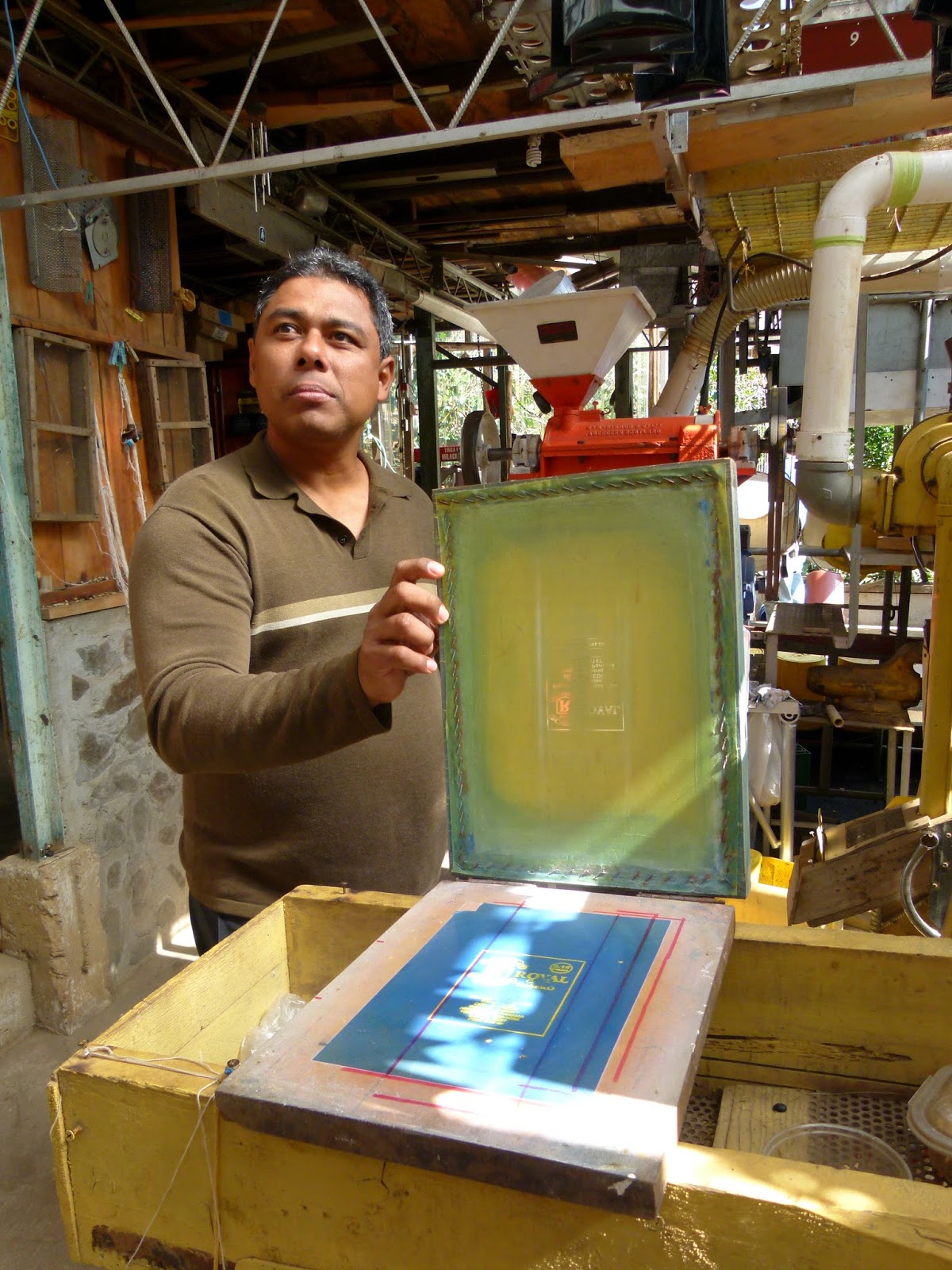
Looking up we saw this huge wasp nest in a distant pine tree. Now we moved inside to see how they silk screen their own bags to hold the coffee.


The beans are put in these bins and then washed. The light ones are not suitable for roasting and they float down and are discarded.


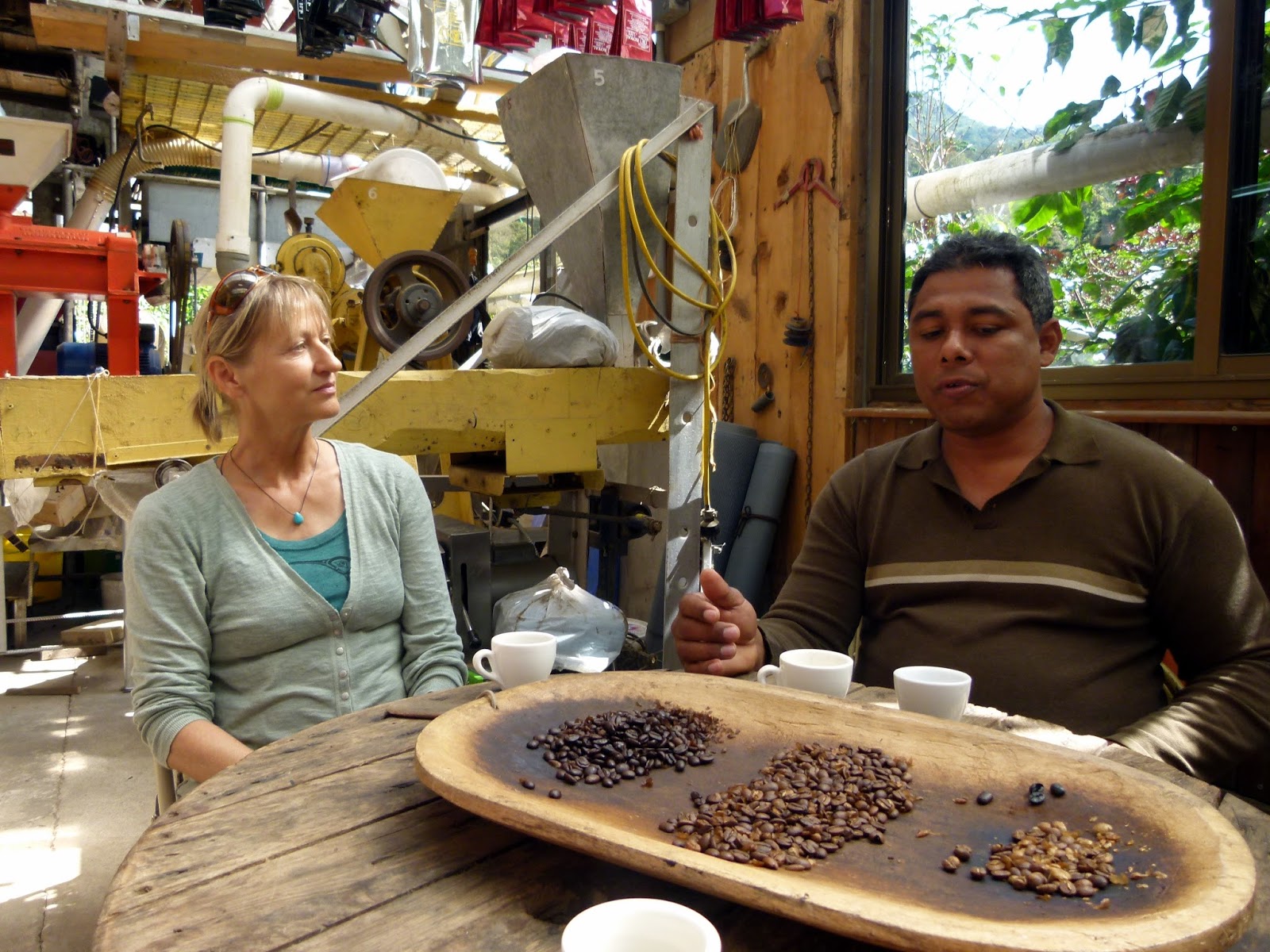
Mr. Tito has made many of his own machines out of parts from cars and other machines.The roaster is made from a headlight and really clever. We watched as the beans were roasted and learned that different types of coffee comes from how long the beans are roasted. Light, then more roasting gives you medium or French Roast and the most roasted beans are Dark or Italian Roast. Interesting fact is the light roast has the most caffeine!


At this point we were served a cup of medium roast coffee. Jeff and I tasted it and after adding sugar I drank my entire cup.

We sat around and learned about the history of coffee with Felix and Ute, a German friend who is in our Spanish class.

On the way home we had this beautiful view of Boquete. Below is a view of Volcan Baru, a dormant volcano which is the highest peak in Panama.


 Purple Bananas

Back in town we went for lunch at a local cafe. Jeff and I had the same plate with chicken, rice and beans, and cole slaw for $3.50 with no tax!


School this afternoon and the topic was verb conjugation.


Wednesday, January 25, 2017

Walking on Sunshine

A fabulous day in Boquete. We got up early to go on our "easy" hike on the Pipeline Trail. We met our guide, John, and group in town and set off in a van passing a lovely waterfall.

We parked near the entrance and our group of eight plus John set off climbing up over 2000 meters on an old cleared road where the pipes bring water down to the town. The road is part of a national park and noted for viewing of the reclusive Quetzal. Apparently this is the beginning of breeding season and the birds are coming in to the area. Quetzals eat a tiny avocado which grows here, but they are not totally ripe yet. We saw these avocados and it takes about 50 of these to make one avocado that people consume.

We saw a few tanagers, warblers and other birds, but I was unable to get photos. We walked up and up and over rocks and roots of trees. The road narrowed and got rougher.


We saw several hummingbirds and found this tiny nest, the smallest of all hummingbirds. Notice the tiny white egg - it is the size of a jelly bean.


John pointed out the smallest orchid. Panama has over 2000 species of orchids.


Tiny avocados

Jeff crossing one of four bridges on the trail.

This pretty sign warns you not to walk here. Why? There are hives of African Killer Bees!

These pretty flowers look like flamingos.

Another bridge

The prize! We were not lucky enough to see a Quetzal, but... we did see this Collared Trogon. It is even harder to find this bird than the Quetzal. She stayed around for quite a while for our viewing pleasure.


John found the tiniest orchid that grows here.

This area has a strange phenomena. As you go higher, the trees are taller and larger as they get more sunlight. This fern is actually growing as a tree.

We learned that there is only one vine growing and it strangles and eventually kills the host tree. All the other "vines" are actually the roots of air plants growing on trees.


This is the largest tree in Panama - a red cedar. 1000 years old and huge!


We got to the top of the trail and turned and headed back down which was much easier. All along the way we saw the pipes that bring the water down to town. Saw these beautiful butterflies.

Glass Wing Butterfly

 Our guide's favorite tree. An oak with red bromeliads growing on it.

A great hike and a bit strenuous for Jeff and me. About three miles and we did it! We got back to town and grabbed a quick lunch and headed to our Spanish class. Amazingly we stayed awake. That's not hard because the teachers are so interesting and do a great job. We only had three people in our class today and we got a lot of attention and got to have good discussions. We only speak in Spanish so this is a great way to learn.

On the way home we stopped at a produce market in town to get a few things. The two guys working there were so sweet bringing me plastic bags and carrying our purchases to the car. This is a great place.


A thought: it is so interesting here. So many different types of people visiting for a few days or staying for months. All ages, many nationalities and the same and different from each other. Everyone is adventurous and we admire that. In our Spanish school we have met students from Canada, Amsterdam, Germany, Bermuda, Bahamas, and Brooklyn. On the hike today there was a couple from Fairbanks, Alaska; Edmonton, Canada and Charlotte, NC. Amazing that the guy from NC grew up in Levittown, PA - our neighbor.